


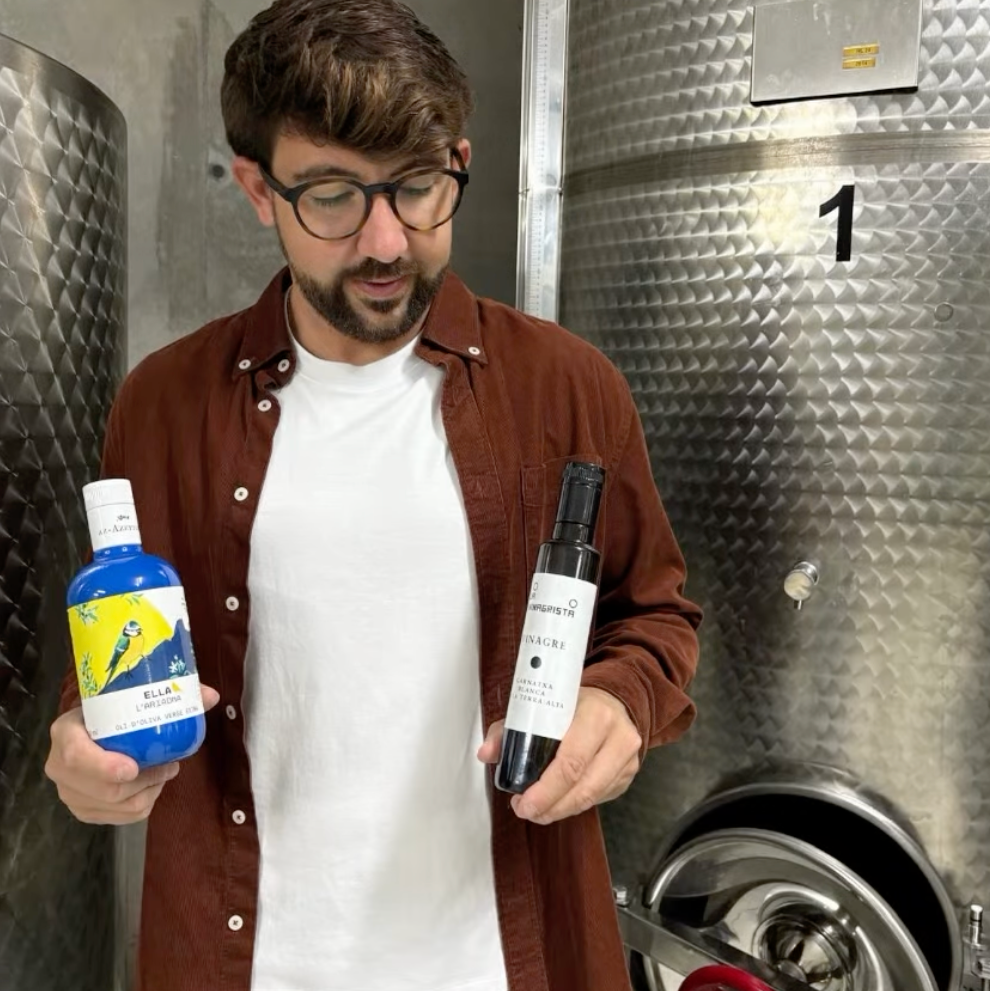
Az-Azeytun
Son of Batea
Region: Terra Alta, Catalonia
Village: Batea (Tarragona)
Cultivars: Arbequina, Oliana, Empeltre
Size: About 4000 trees, all around Batea, producing about 10-12000 liters annually
Minds Behind: Abel Maijo
Abel Maijo refers to himself as a “peasant entrepreneur”. Having originally studied viticulture, he uses the commonalities between tending vines and tending orchards in heritage olive cultivation. Nearly a third of all agricultural land in Terra Alta is dedicated to olives, including one of the oldest trees, “La Parot”, estimated to be 2000 years old.
The name Az-Azeytun comes from the Arab word meaning “the land of olive trees” and was noted in the 10th-12th century by the writer Al-Adrisi. The Spanish word for olive–aceituna, can easily be derived from this spelling.
Our years in the wine business allowed me to crisscross Terra Alta a dozen times, always on the lookout for a concentrated Garnatxa, or a refreshing Cava. But I never really landed on the right winery, at the right place, at the right time. Still, we had a fondness for this region, its raw beauty, fantastic food, and warm, inviting people. When it was time to look outside the box for olive oil (most of Spain’s production comes from Andalusia in the south), Terra Alta seemed like a good place to start. We read an article about a young guy doing something new in a quiet, isolated village, and made a phone call.
Abel’s mill is located on a small side street below Batea’s elementary school. It’s something of a dusty old town, with not much by way of modern conveniences, but he's renovated the old garage into an efficient and clean facility. It's unique and different, which we love.
The first time we visited Abel, it was at the end of a three-appointment day. Very nice people at the first two, but both with oils that might be thought of as a little more “rustic” and old-school. Oils that are lackluster, or showing slight flaws, are almost always the result of poor or unhygienic milling. Oxygenation during processing, poor filtration, lack of temperature-controlled storage – all those things can quickly degrade an oil, and quite frankly, take away all its extra virgin qualities. From the moment we stepped into Abel’s converted garage, saw all his gleaming stainless steel and refrigeration, and tiptoed around on his clean floors, we knew we were somewhere different.
Blue glasses.
Abel must have dirtied three dozen glasses when we first tasted with him in 2025. He was animated and totally fired up to show off one oil after another that reflected what he was doing. Each oil was tasted blindly, from a small, cobalt blue glass that professionals consider to be the “official” and best tasting glass for olive oil. As his oils warmed in our hand, and the aromas began wafting up to our nose, we were treated to what I can only describe as an “explosion” of sensations. Some oils reveal themselves slowly, and some leap into your senses with purpose and immediacy. What was going on here?
Terra Alta is a pretty hot place, and without temperature-cooling equipment, the production of olive oil can be doomed from the start. So imagine the difference when we learn that Abel drops the temperature of his olives to nearly 5 degrees in order to begin the malaxation process. He claims this allows for a great concentration of his finished oil, guards the olives' natural esters and aromas, and protects the flavors. From tree to oil there is a total duration of just about 3 hours. Being in control of your own mill and your own schedule allows for that. It’s something of a litmus test for us as olive oil seekers and importers. Own mill, good. Someone else’s mill. Less good.
Abel bottles oils only as monocultivars, and only from varieties that are particular and native to Catalonia. His Oliana is a variety that grows abundantly, but is often harvested early and, as such, has a very low yield. It’s not a particularly spicy or bitter oil, and instead could be considered to be more fruity – think golden and green apples - than savory. For me, the texture was the key here, and pointed to using it on hearty leafy greens like romaine or cress or curly endive (salade lyonnaise?).
From there, we moved to Arbequina (Arbequi in Catalan, and on the label), a well-known cultivar for eating, with a variety of colors and a small, round shape. Thought to originate from Palestine, and brought to Spain during the 16th century, it grows abundantly. Due to a later harvest than Oliana, it yields a bit more oil per kilogram, despite its petite size. The taste profile tends more toward aromatic leafy herbs like arugula, fennel, and sage. This oil moves us up the bitter/spicy scale a bit too, with a mild piquancy and something like citrus zest. I would consider this to be one of our polyvalent (multi-purpose) oils, ready for something simple like dunking bread, dripping onto a radish, coating a chicken before roasting, or sloshing all over roasted vegetables right before service. You’ll want this one in the largest format possible.
And then we came to the hidden gem–Empeltre. Spanish black olives, super-ripe and toothsome, are often made with this cultivar, but when harvested earlier, while still green, yield an olive oil that is simply extraordinary. We learned that many of the locals don’t really care for Empletre as it is often too bitter and spicy for them. But for my palate, it is just perfectly in balance, and sensationally broad. There’s an entire aroma wheel of olive oil goodies that shows up here, from green almond to green tomato to chicory and to artichokes. A couple drips on something as simple as a baked potato would make it explode with flavor. Roast a piece of fish, season your seafood rice, and drown your chicken or ham croquettas.

