


TRESPALDUM
Terra dell’Olio
Region: Molise
Village: Mafalda (Campobasso)
Cultivars: Leccio del Corno, Leccino, Gentile di Mafalda
Size: About 3,500 trees (at 350m altitude), producing about 10,000 liters annually.
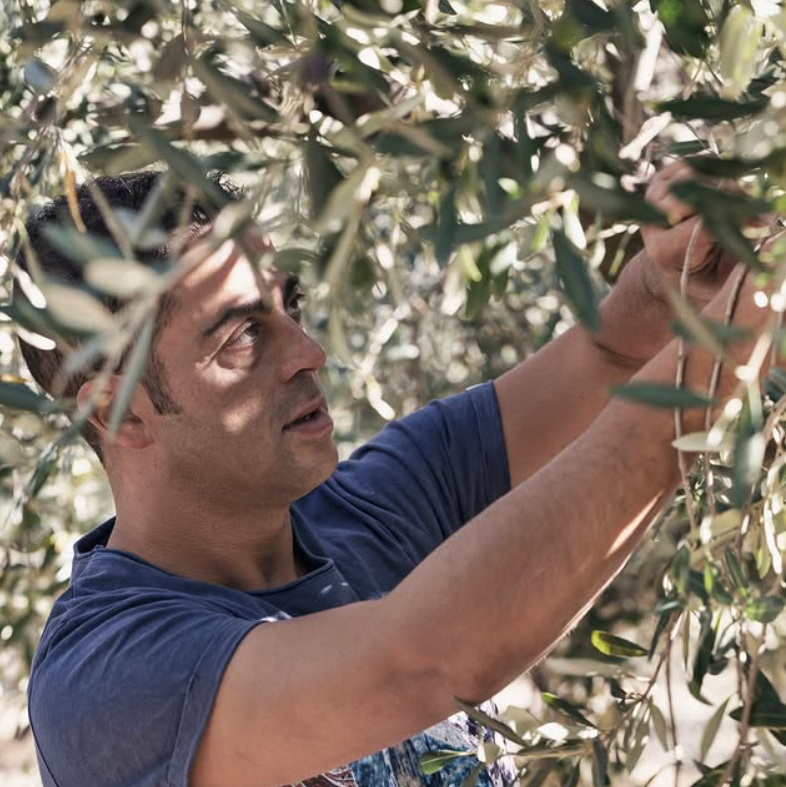
Miller and Mind Behind: Francesco Mastrangelo
Francesco greets us warmly at the mill, his sister offering a bit of useful translation, and his mother never far away (no doubt wondering what these Americans and their dog are doing at the mill, and how on earth they even heard about them in the first place).
Francesco worked as an olive miller from his high school years, and in 2006 convinced his parents to invest in their own mill. Using the know-how he had acquired, they began with used equipment, slowly converting their mill over 20 years to what can now be considered one of the most premium mills in the region. It is not only hyper-clean and contained, but it's also powered by renewable energy. Recapturing and reusing every input, their processing results in zero waste.
After viewing the mill, we follow Francesco to a tiny office next to a hangar housing tractors and other farm equipment. The lineup is immediately welcoming, with bright, sunny labels, and beautiful, rounded bottles. But when the tasting begins, function quickly outperforms form. Trespaldum’s oils are everything we want - hitting every mark on the spectrum. These are clean, flavorful, and will unquestionably take any dish to the next level.
It has become a rite of passage in the wine business to endlessly adjectivize what is being tasted. But olive oil doesn't force that notion upon us. A really great oil has a way of immediately conjuring thoughts such as, “Wow, I just want to drown a tomato in this stuff!” Or, “Can you imagine poaching a piece of salmon in this one?” Regardless of the taster's experience with food or cooking, an honest question when tasting olive oil should be, “Does that make me want to use it in my kitchen?” It should be that simple.
Francesco starts us with a specially selected blend he simply calls Biologico ("organic" in Italian). The aroma reaches you a good foot from your nose, exploding with cut grass, tomato leaves, and artichoke. From there it hits the palate with an herb-packed green note and a medium spiciness. The thing that seals the deal are the fine bitter notes, a sort of chicory element that arrives on the palate after 5-7 seconds. This allows the initial piquancy to pass, and leaves the mouth with a slightly tactile feel. We use this oil at home for everything from dousing fresh arugula with big, thick parmesan shavings, to making our favorite olive oil pastry crust, to frying a couple over-easy eggs. The fragrance when the oil first warms up envelops the entire kitchen.
Francesco then moves us along to his two signature blends, pouring them side by side. These are the lineup he refers to as Mastrangelo Selezione, and they couldn’t be more different. He calls them both fruttato (fruity), and they are, with fresh, green, herby aromas leaping into the nose, but to go a step further, he calls one leggero (soft or light) and the other intenso (yeah, you guessed it, intense). As you can imagine, the leggero is easy to love, usable for anything, but probably best for coating your vegetables prior to roasting and grilling. The Intenso, though - that’s the one you might want to save for the end, for use on raw food like scallop carpaccio and raw, shaved vegetables like radishes or kohlrabi. It’s amazing how far just a few drips of this stuff will go!
Finally, Francesco proudly shows us his monocultivar, a single olive variety that only he grows called Gentile di Mafalda. The Mastrangelos always knew their trees yielded fruit that was different from that of their neighbors, but it wasn’t until they had the cultivar tested in 2017 that they were able to get protected status for it. It's now bottled separately from their other oils, as it comes from one place on the planet: their own village.
Olive oil bullshitters often use the term organoleptic to discuss some of the sensory stuff we’re smelling and tasting. What we’re talking about are the brushes that paint a picture of taste, aroma, and texture. When I taste Francesco’s Gentile di Mafalda, I go into organoleptic overload. Everything about it is just…perfect. There’s a pronounced chicory and artichoke aroma laced with cut green grass and sweet herbs. In the mouth, the weight is silky and generous, and the bitter/spicy balance is perfectly on point.
This is the oil that you want smack in the middle of the table - the one you make a small pool on your plate with when you’re enjoying a perfectly grilled steak, a barbecued chicken, roasted mushrooms, risotto, you name it. But only AFTER cooking. It’s like adding really good salt to the top of a dish after plating it up. And don’t be shy, use it generously! You’ll be using a bit of bread (or your fingers) to mop up what’s left on the plate at the end.
As all good food should, Francesco’s oils reflect the area from which they come. We really like this mountains-meets-the-sea region of southern Abruzzo for its blue sky, verdant rolling hills, herbaceous fresh air, and of course, its culinary wonders.
And speaking of… here's a word about gas stations.
Mafalda is not exactly a commercial center. About 1,000 people reside there, and the six neighboring villages don’t even add up to half that many more. So on a quiet Wednesday afternoon in January, after loading our first order from Trespaldum into the truck, we knocked on the door of the neighboring agriturismo. Closed. We looked up some alternatives, but those were all 30 minutes back to the coast. Finally, Francesco's sister pointed us to Il Girasole (the sunflower), tucked in behind the Smart Oil station along the SS650. There we were treated to what strikes us as the best 15€ lunch money can buy. Toothsome fresh pasta with a light sauté of local cabbage, followed by perfectly grilled pork chops and drizzled with good olive oil. Strong Italian espresso from one of those old, nickel-plated machines sealed the deal, and fired us up for the next 300 kilometers. We were in and out in about 22 minutes, dining with truckers, cable installers, and tractor drivers. We'd go back a thousand times.
As we paid the tab and headed for the door, Francesco’s oil was right there on the shelf - for sale and undoubtedly being used in the kitchen. Bellissimo!

